


Is Auroville a Failed Utopia? (55 Years Later)

Updated: Jul 28
If You Saw Auroville from Space, You Might Think It Belongs to Another Planet!
It looks like a landing site. A galaxy-shaped grid carved into the red earth of Tamil Nadu.
In 1968, 5,000 people gathered here to start a new civilization. No money. No government. No religion. They called it Auroville.
But nearly 60 years later, this visionary utopian project has become a heated battleground. Today, we are going to explore what happens when you try to masterplan utopia and what we have learned from Auroville 60 years after its conception. We are asking the question: is Auroville a Failed Utopia?
Is Auroville a Failed Utopia? The Arrival: Access to Eden Isn't Free
Leaving the chaos of the real world behind, riding towards Auroville feels like an adventure. You navigate past cows and small villages that seem ancient, searching for a treasure hidden among thousands of trees.
"I think I missed the turn... again!"
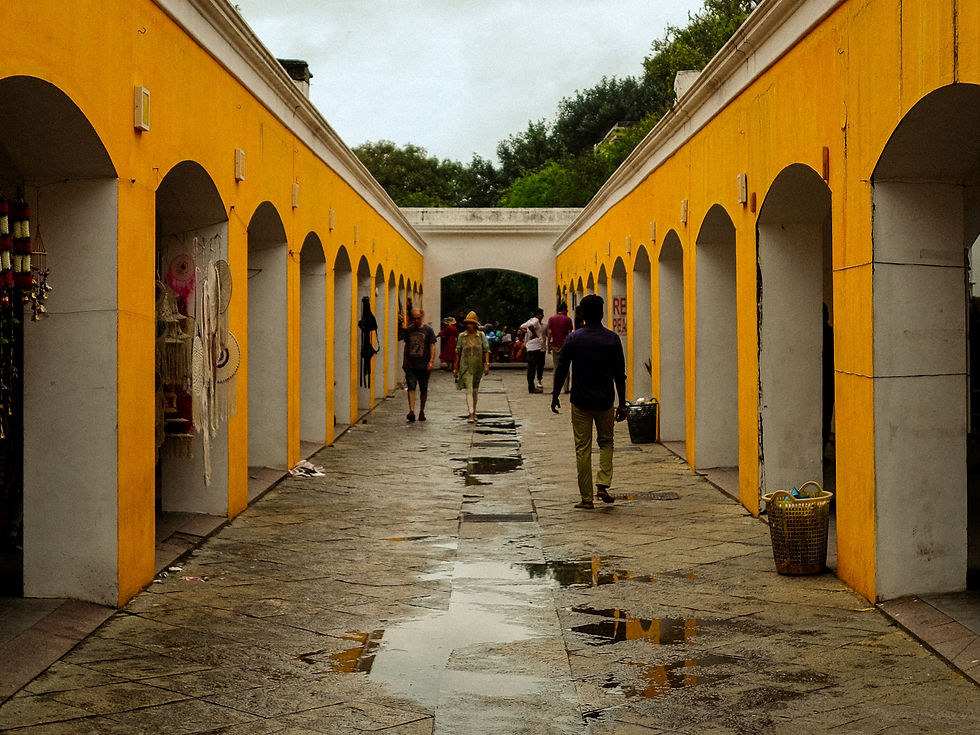
Arriving is quite an unusual experience. First, you pay for parking (because access to Eden isn’t free). Then, you walk through the 'Tourist Trap,' a timeline of the project, cafes, and stalls selling clothes, before finally purchasing a ticket to walk a path to the viewing platform.
As you walk, you start to wonder if you should be there at all. It feels like that line from The Beach: "It suddenly dawned on me, we weren't even invited."
The Vision: A Laboratory for the "Supermind"
Auroville isn't an organic city like Pondicherry; it is an intentional community born from the collaboration of two remarkable individuals: Sri Aurobindo Ghose and Mirra Alfassa (The Mother).
Aurobindo’s philosophy was radical: Evolution is not finished. Just as life emerged from matter, and mind from life, a higher consciousness called the "Supermind" is destined to emerge.
The Mother sought to give this philosophy a physical form. She envisioned a "universal township" where:
"Men and women of all countries are able to live in peace and progressive harmony above all creeds, all politics, and all nationalities."
The Architecture of the Soul
The task of translating this spiritual vision into an urban form fell to French architect Roger Anger. His 1968 "Galaxy Plan" envisioned a city of 50,000 inhabitants arranged in a spiral.
At the centre lies the Matrimandir (Temple of the Mother).
The Outer Shell: Covered in 1,415 golden discs. These aren't solid gold, but stainless steel covered in gold leaf and fused between glass to protect them from the corrosive salt air.
The Inner Chamber: A dodecagonal room of pure white marble. No idols. No flowers. No incense.
The Crystal: In the center sits the largest optically perfect glass globe in the world (70cm diameter) by Zeiss.
The Ray: A computer-controlled heliostat on the roof catches a single ray of sunlight and shoots it vertically down into the globe.
It is a stunning feat of engineering designed to represent the descent of Divine Consciousness into the earth.
The Reality Check: When Plans Hit Physics
The site chosen for this utopia was a barren, sun-baked plateau anchored by a single Banyan tree. On inauguration day in 1968, representatives from 124 nations poured soil from their home countries into a single white marble urn, mixing the earth of the planet together.
But there was no money for the high-rise megastructures in the Galaxy Plan. Instead of a concrete metropolis, the early pioneers built simple huts of plaited palm leaves (keet) and focused on survival. They planted millions of trees to stop the fierce soil erosion.
Here is the cruel irony: The "Galaxy" concept assumed a blank canvas. But 50 years later, the canvas is no longer blank. It is a lush Tropical Dry Evergreen Forest, a rare ecosystem meticulously regenerated by the very residents who envisioned the future.
The trees saved the land, but now they are blocking the city.
The Conflict: Bulldozers in the Peace City
The population has stalled at around 3,000, far short of the 50,000 goal. Frustrated by the "stagnation," the Government of India intervened in 2021 to force the implementation of the original Master Plan.
The target? The Crown Road. A 16.7-meter wide circular road meant to connect the city's four zones. The problem? It cuts straight through the forests the residents spent 40 years planting.
In December 2021, all hell broke loose. Bulldozers arrived, sometimes at night. Residents stood in front of machines in non-violent protest. The images of "police vs. hippies" in a peace township shocked the world.
The Foundation argues that residents have become complacent "squatters" in a private eco-resort, failing to build the city the world needs. The residents argue that a rigid 1960s geometric plan shouldn't destroy a 2020s ecological success story.
The Final Cost
Beyond the trees, there is the money. Since the Foundation doesn't fund housing for everyone, newcomers often have to "donate" the cost of an apartment, rumored to be $35,000 - $70,000 USD or more. This unsecured "donation" gives you a right to live there, but you own no asset.
Critics argue this financial barrier effectively bans the poor, turning Auroville into an elite enclave rather than a place for "humanity as a whole."
Reflections on Auroville: A Beautiful Complexity
Auroville is a fascinating, beautiful, and complicated place. It is a testament to what humans can build and a warning of what happens when dreams meet reality. The journey of Auroville raises essential questions about community, sustainability, and the essence of utopia.
What does it mean to create a place where everyone belongs? Can we truly design a perfect society? As we ponder these questions, we can’t help but admire the spirit of those who dared to dream big.
🗺️ Exploring Tamil Nadu?
Check out my guide to the architecture of Chidambaram, where 1,000-year-old engineering shows absolutely ... Nothing!
🎥 Watch all the Documentaries at Backpacker's Blueprint
See Pondicherry (Puducherry), Chidambaram, Auroville, and more as we journey through the world by its architecture. Only at Backpacker's Blueprint


Comments